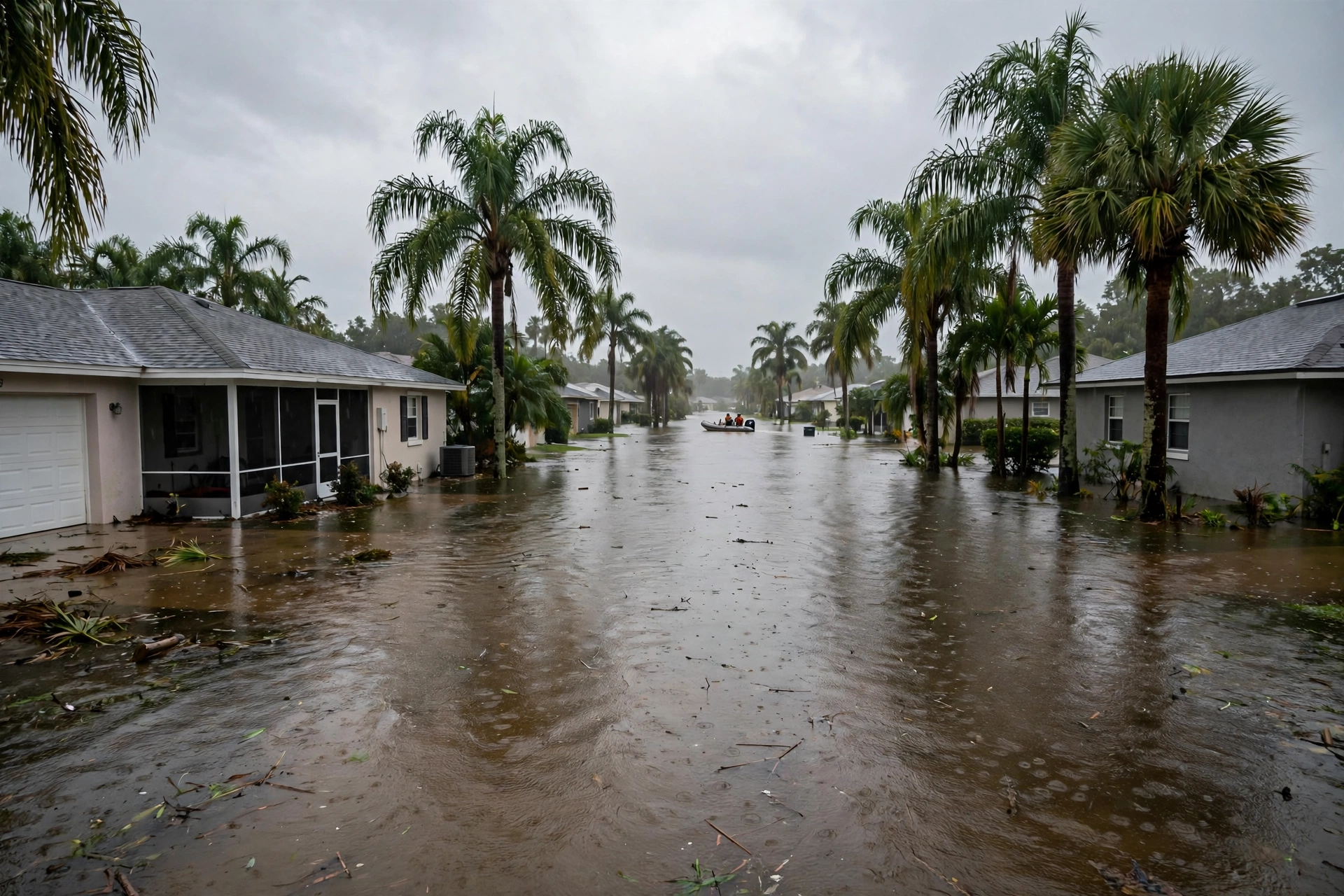
Brevard County's 1-in-1,000-Year Rain — and the River Still Rising
November 1–2, 2026: up to 24 inches of rain on Florida's Space Coast, a Flash Flood Emergency for Palm Bay and Melbourne, and a St. Johns River forecast to keep rising for weeks.
Published November 5, 2026 · WaterDamageEmergencyNow
What Happened on the Space Coast
A stalled low-pressure system — not a tropical storm — pulled deep tropical moisture over Florida's Atlantic coast on Sunday, November 1, and Monday, November 2, 2026. By Monday afternoon, southern Brevard County had taken rain the National Weather Service called a one-in-a-1,000-year event.
- 23.69 inches of rain at Grant-Valkaria, which forecasters called ground zero for the storm.
- Up to 24.10 inches measured near Malabar across November 1–2 (Weather Prediction Center summary).
- 19.75 inches at Palm Bay.
- 11.04 inches at Melbourne's official gauge — the city's all-time 24-hour rainfall record, breaking its daily and monthly records with it.
- 7:56 a.m., Monday, November 2: the National Weather Service in Melbourne issued a Flash Flood Emergency — its most urgent flood alert — for Palm Bay, Melbourne, and West Melbourne, later adding Grant-Valkaria.
Rescue crews worked through the day. Reporting from the county put high-water rescues above one hundred, with the Brevard County Sheriff's Office and the Florida Fish and Wildlife Conservation Commission both running boat rescues, and two Palm Bay residents died in the flooding. Governor Ron DeSantis declared a state of emergency for seven counties on November 2 (Executive Order 26-227), and Brevard's public schools stayed closed through Wednesday, November 4.
The Second Flood: The St. Johns River
Brevard's rain does not stay in Brevard. The St. Johns River flows north from Brevard County toward Jacksonville, and the water that fell on Palm Bay and Malabar is now moving down that river. On Wednesday, November 4, the governor widened the state of emergency to 14 counties (Executive Order 26-228), adding Lake, Seminole, Volusia, Palm Beach, Okeechobee, Glades, and Hendry to the original seven.
- St. Johns River near Cocoa: 16.8 feet at 8:15 p.m. Wednesday, November 4 — already in moderate flooding, with flood stage at 16.0 feet. The National Weather Service forecasts major flooding late this week, holding through the weekend.
- At 17 feet near Cocoa, roads flood and water approaches low-lying homes in the Silver Pines area.
- Near Sanford, the river is forecast to reach minor flood stage Friday and crest near 6.4 feet by Monday.
- Flood warnings also cover the river near Astor and near DeLand, and forecasters expect minor to moderate St. Johns flooding to last for weeks, not days.
If you live along the St. Johns in Brevard, Seminole, Lake, or Volusia County, this is a rising-water problem on a schedule — the rare flood you can see coming days ahead. The directory pages for Melbourne and Palm Bay carry the local provider listings for the cleanup already underway.
What Brevard Homeowners Do Next
1. Treat floodwater as contaminated. Twenty inches of street and creek water is not clean water. Keep children and pets out of it, and do not run a shop vacuum and call it done.
2. Mind the boil-water notices. Notices remained in place for parts of Brevard County, including areas of Melbourne, as the county moved from rescue to recovery this week.
3. Document the water line. Photograph every room's high-water mark before cleanup. Flood claims live and die on that documentation.
4. Get extraction and drying started now. In Florida humidity, the 24-to-48-hour mold window is the whole ballgame. What professional cleanup costs after a flood like this one is broken down in
our flood cleanup cost guide.
Sources for this article: National Weather Service Melbourne (Flash Flood Emergency, November 2, 2026; rainfall totals; St. Johns River flood warning, November 4, 2026); Florida Executive Orders 26-227 and 26-228; Florida Today and Weatherboy reporting on the Melbourne record and rescues, November 2–4, 2026; Central Florida Public Media, November 4, 2026. Rainfall figures are preliminary National Weather Service totals.
Questions, Answered Straight
Was the Brevard County flood caused by a hurricane?No. The National Hurricane Center listed no Atlantic cyclones that weekend. A stalled low-pressure system pulled deep tropical moisture over Florida's Atlantic coast and dropped up to about 24 inches of rain near Malabar on November 1-2, 2026, which the National Weather Service called a one-in-a-1,000-year rainfall event.
How long will the St. Johns River stay flooded?Forecasters expect minor to moderate flooding on the St. Johns River to last for weeks as Brevard County's record rainfall drains north. Near Cocoa, moderate flooding was already occurring on November 4, 2026, with major flooding forecast late in the week and water approaching low-lying homes in the Silver Pines area at 17 feet.
Does homeowners insurance pay for this kind of flooding?Generally, no. Water that rises from outside the home is flood damage, which a standard homeowners policy does not cover; it requires a separate flood policy. That is why photographing where the water came from, and how high it rose, matters for every Brevard County claim this week.
Standing in Water Right Now?
Every hour raises the bill. Send the form and a coordinator calls you back within minutes — a real person, 24/7.