Get Help
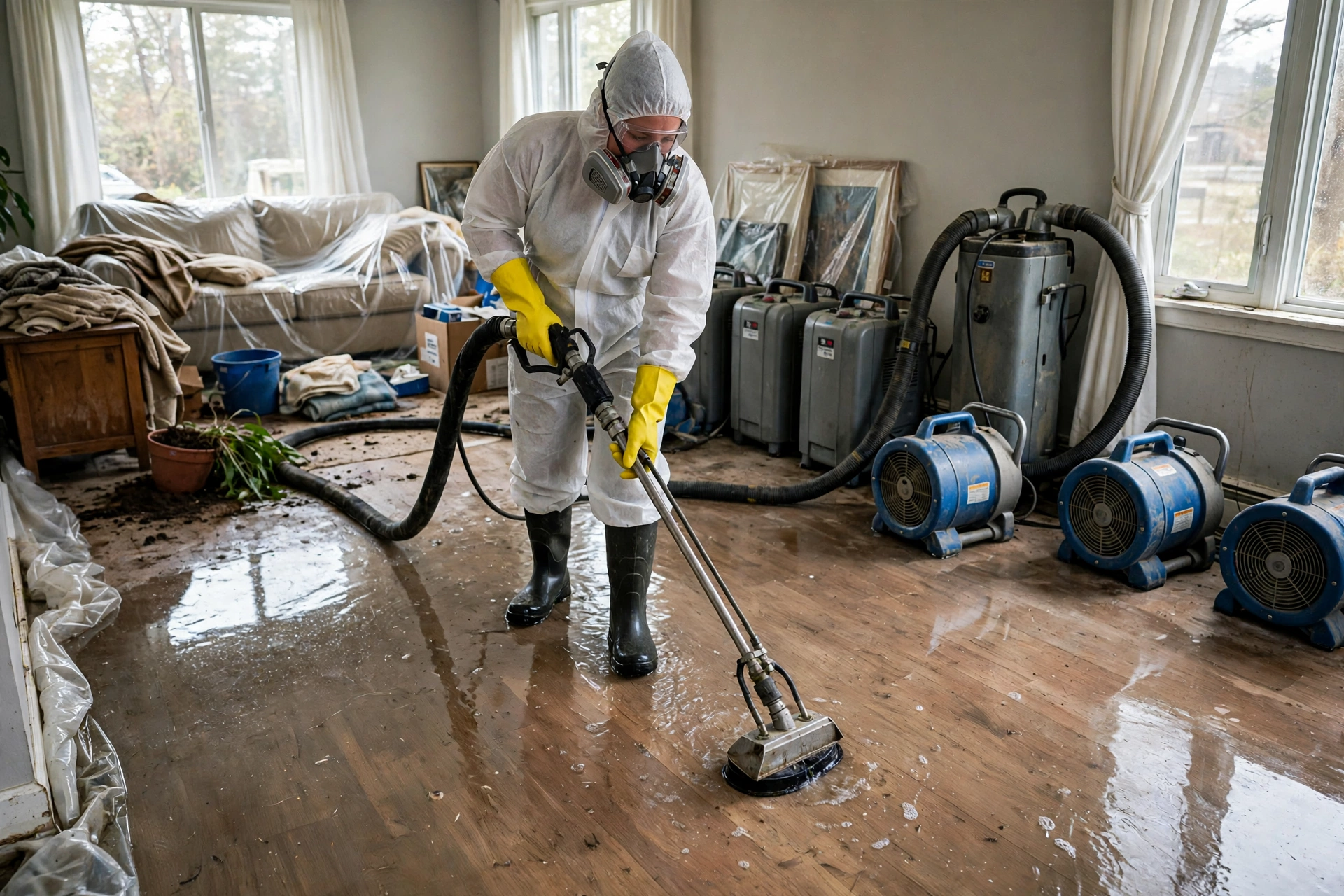
Restoration worker extracting floodwater from a home's living room

The Cost of Waiting: A Rising River Bills by the Day

The daily cost guide: a slow river flood is the most expensive shape water damage takes - not because the water is deeper, but because the category climbs, the mold window closes, and the salvageable list shrinks while the water sits.

Published November 11, 2026 · WaterDamageEmergencyNow

Water damage in your home? Send this form.

A local crew gets it and calls you back.

A coordinator for your area is alerted the moment this lands. No obligation.

The Scenario: a River That Gives You a Week, and Charges for It

The St. Johns River near Cocoa has been in major flood since the weekend, and its crest — 17.2 feet, the stage where water enters Lake Poinsett homes — is not due until this weekend. That is the most expensive shape a flood can take. A burst pipe floods a room in an hour and the clock starts when you find it. A slow river flood starts the clock days before the water arrives, and keeps it running while the water sits. This is the daily cost guide, and its subject is what waiting does to the bill, at real 2026 prices.

Mitigation, per square foot of wet footprintPrice (Angi, 2026)
Category 1 — clean water (a supply line, caught fast)$3–$4 per sq ft
Category 2 — grey water (water that has sat, or carried contaminants)$4–$6.50 per sq ft
Category 3 — black water (river and flood water, by definition)$7–$7.50 per sq ft
Average water damage restoration job, measured nationallyAbout $3,874
Mold remediation, average jobAbout $2,368 ($10–$25 per sq ft)

Run one worked example on those bands, labelled as arithmetic, not a quote: a 1,000-square-foot wet footprint dried as clean water costs roughly $3,000 to $4,000 in mitigation. The same footprint after a week of river water, priced as black water, runs $7,000 to $7,500 — before any rebuilding, and before mold. Waiting roughly doubles the mitigation bill. Independent restoration-industry guides put the Category 3 top end higher still, toward $12 per square foot where every porous material comes out.

The Three Clocks That Price the Waiting

1. The mold clock: 24 to 48 hours. The Environmental Protection Agency's mold guidance is the deadline the whole trade works by: materials dried within 24 to 48 hours of getting wet will, in most cases, not grow mold. A home waiting out a weekend crest has no way to stay inside that window while water is still standing — which is why mold remediation, averaging about $2,368 at $10 to $25 per square foot, becomes a second bill on prolonged floods rather than a risk. Extensive whole-house remediation runs $10,000 to $30,000.
2. The category clock: water gets worse standing still. Restoration work is priced by water category, and the category is not fixed at the moment of the flood. Water that sits for 48 hours or more is treated as a higher category, and river floodwater is Category 3 from the start — sediment, bacteria, and possible sewage. Under the industry's IICRC S500 standard, porous materials that Category 3 water touches — drywall, insulation, carpet and pad — are typically not dried and kept. They are removed and discarded. Every day of sitting is a day more of the house crosses from the dry-it column into the remove-it column.
3. The drying clock: 3 to 5 days, starting when the water lets it. Once extraction can begin, a professional dry-out still takes 3 to 5 days of equipment time, verified by moisture readings. On a river flood, that clock cannot start until the river falls — on the St. Johns, homes near Lake Poinsett are looking at a crest this weekend and a slow fall behind it. The preparation that is still free this week is the preparation done before the crest: what today's live update lists for Cocoa, Sanford, and DeLand is in Wednesday's St. Johns report.
4. The honest top end. Cost guides class prolonged flooding that saturates hardwood and concrete to the core — Class 4 in the trade's scale — at $15,000 to $100,000. That is the disaster class, not the average, and it is printed here labelled as such: it is where a week-long river flood can land, and it is not where a same-day extraction lands. The measured national average job, about $3,874, is what the fast version of this story costs.
What Waiting Buys, and What It Doesn't

Figures on this page: Angi cost data, 2026 (water damage repair $3 to $7.50 per square foot overall; by category, Category 1 clean water $3 to $4, Category 2 grey water $4 to $6.50, Category 3 black water $7 to $7.50 per square foot; national average water damage restoration job $3,874, September 2026 update; mold remediation average $2,368 at $10 to $25 per square foot, extensive remediation $10,000 to $30,000); U.S. Environmental Protection Agency, A Brief Guide to Mold, Moisture and Your Home (materials dried within 24 to 48 hours will in most cases not grow mold); IICRC S500 category framing as published in restoration-industry guides (standing water reclassified with time; river floodwater Category 3; porous materials typically non-salvageable); HomeGuide class framing via published cost guides (Class 4 prolonged flooding $15,000 to $100,000, labelled as the disaster class). The worked example is arithmetic on the published per-square-foot bands. Prices are ranges, not quotes.

Questions, Answered Straight

How much more does water damage restoration cost if you wait?

Roughly double the mitigation bill, on published 2026 bands. Angi prices mitigation at $3 to $4 per square foot for Category 1 clean water and $7 to $7.50 per square foot for Category 3 black water - and river floodwater is Category 3 by definition, while water of any kind that sits 48 hours or more is treated as a higher category. A 1,000-square-foot footprint dried as clean water runs about $3,000 to $4,000; the same footprint after a week of river water runs $7,000 to $7,500 before rebuilding or mold work.

Why does a river flood cost more than a burst pipe flood?

Category and time. A burst pipe starts as clean water and can usually be extracted the same day, inside the EPA's 24-to-48-hour mold window. River water is Category 3 from the start - sediment, bacteria, possible sewage - so porous materials it touches, like drywall, insulation, and carpet pad, are typically removed rather than dried under the IICRC S500 standard. And a slow river keeps homes wet for days before drying can even begin, which adds mold remediation - about $2,368 on average - as a second bill.

How long does it take to dry a house after a river flood?

The drying itself typically takes 3 to 5 days of professional equipment once it can start, verified by moisture-meter readings. After a river flood it cannot start until the water recedes enough for a crew to work - on Florida's St. Johns River in November 2026, the crest near Cocoa was still days away a week into the flood, so flooded homes faced the crest, the fall, and only then the 3-to-5-day dry-out, with the mold window long past.

Keep Reading

Standing in Water Right Now?

Every hour raises the bill. Send the form and a coordinator calls you back within minutes — a real person, 24/7.

Water damage in your home? Send this form.

A local crew gets it and calls you back.

A coordinator for your area is alerted the moment this lands. No obligation.

Back to Submission Form Click here ↑
📞 Call — pending activation Request a Callback